How to install stone or brick cladding? Complete Matiera Guide

Do you want to successfully install your claddings, floor tiles or brick slips? This guide provides practical advice and essential steps to optimise the installation and maintenance of your Matiera products.

Each product comes with a detailed technical datasheet, essential for knowing the exact layout. If in doubt, our team is available to answer all your questions.

1

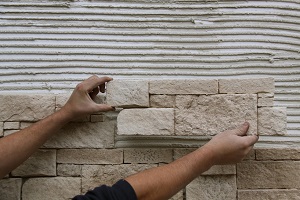
Mesh installation — speed and practicality

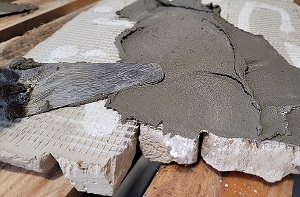
Mesh installation ensures stable and durable fixing. Ideal for covering large surfaces quickly.

① Prepare
Clean, dry and smooth wall. Apply a bonding primer.
② Bond
Double bonding — wall and mesh — with a notched trowel.
③ Install
Follow the collection layout plan. Align each element.
④ Finish
Remove excess adhesive. Apply waterproofing outdoors or in wet rooms.
Mesh installation step 1 Mesh installation step 2 Mesh installation step 3
2

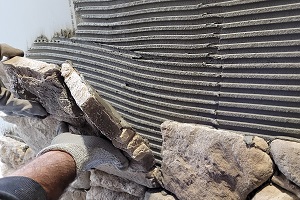
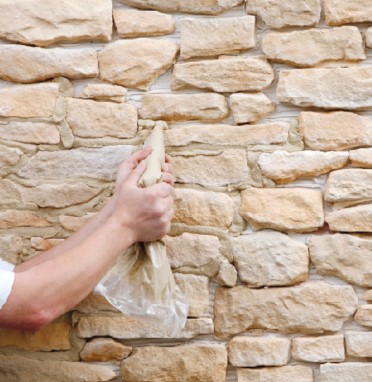
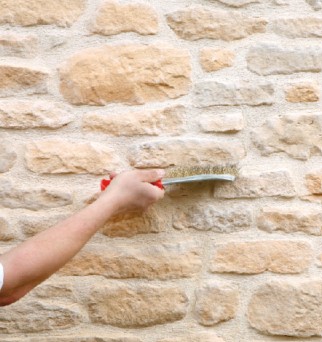
Jointed installation — traditional and solid finish

Ideal for a traditional and robust finish. The joint (1 to 2 cm) gives an authentic look, perfect for rustic styles.

① Position
Maintain a spacing of 1 to 2 cm between each stone.
② Grout
Fill the joints with a mortar suited to stone.
③ Smooth
Smooth with a float for an aesthetic and durable finish.
④ Waterproof
Apply a waterproofing agent for outdoor and wet room installations.
Jointed installation step 1 Jointed installation step 2 Jointed installation step 3
3

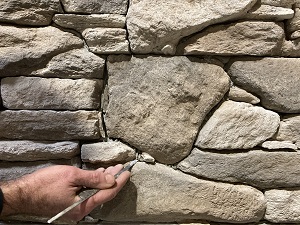
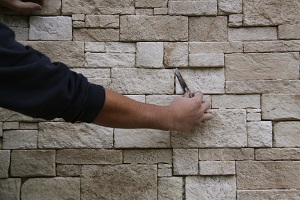
Jointless installation — modern and contemporary result

Edge to edge, without spacing. Ideal for a contemporary and uniform effect in modern interiors.

① Prepare
Perfectly smooth wall. Apply ORFLEX adhesive.
② Install
Cladding edge to edge. Precision is essential for the finish.
③ Clean
Remove excess and adhesive streaks immediately.
④ Waterproof
Protect outdoors or in wet rooms.
Jointless installation step 1 Jointless installation step 2 Jointless installation step 3
4

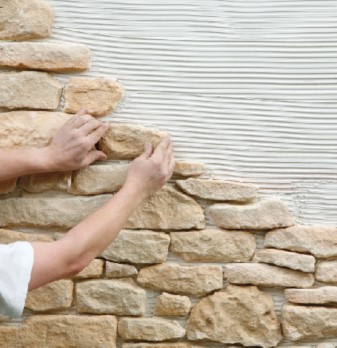
Brick slip installation — authenticity and tradition

Brikelia brick slips bring a unique charm to your interior and exterior walls.

① Prepare
Clean the wall, apply a bonding primer.
② Bond
Apply special adhesive on the wall and on the slips.
③ Grout
Fill and smooth the joints with specific mortar.
④ Clean
Remove excess after drying. Apply waterproofing outdoors.
5

Noviroc floor tile installation — charm and authenticity

Perfect for bringing authenticity and charm to your interiors, terraces and gardens.

① Prepare
Sand or mortar bed for a stable base.
② Lay
Follow the layout plan suited to your project.
③ Fill
Fill the joints for stability and aesthetics.
④ Finish
Check alignment and level for an impeccable result.
6

Paving installation — stability and outdoor elegance

Ideal solution for landscaping your outdoor areas in a durable and aesthetic way.

① Level
Levelled and compacted ground. Sand bed for installation.
② Lay
Pattern of your choice, alignment and stability checked.
③ Stabilise
Joints filled with sand or mortar to stabilise.
7

Maintenance — extending the durability of your claddings and floor tiles

Cladding maintenance
Soft brush and clean water for surface dirt.
Specific solvent-free products for stubborn stains.
Apply a waterproofing agent every 3 to 5 years to extend lifespan.
Floor tile maintenance
Water and brush to remove residues regularly.
Specific anti-moss products for stubborn dirt.
Renew joints as needed to maintain stability and aesthetics.
→ View our waterproofing agent
Frequently asked questions about installation
Everything you need to know before starting
Which adhesive should I use to install stone cladding? +

We recommend our ORFLEX tile adhesive (class C2TE), available in our shop. It is suited for indoor and outdoor installation on all types of surfaces. For absorbent surfaces, apply a bonding primer before adhesive.

→ View our installation accessories

Is a bonding primer needed before installation? +

Strongly recommended on porous, friable or overly smooth surfaces (smooth concrete, OSB, new plaster). It improves adhesion and reduces the risk of detachment. On a hard and sound surface, it may be optional.

What is the difference between mesh, jointed and jointless installation? +

Mesh — the fastest, ideal for large surfaces.
Jointed — authentic traditional look, rustic styles.
Jointless — contemporary and uniform effect, modern interiors.

How long should I wait before applying the grout? +

Wait 24 to 48 hours depending on ambient temperature and humidity. Never grout over adhesive that is still fresh.

Does interior cladding need waterproofing? +

In a dry room, optional but recommended for maintenance. Essential in bathrooms, kitchens, utility rooms and outdoors.

→ View our waterproofing agent

A project underway? Need advice?

Our team is available Monday to Friday from 9am to 5pm.